
 Factoring Support
Why Smart Enterprises Are Turning to Factoring Support Services to Fix Their Balance Sheets

June 25, 2026
|


Content
Most enterprises treat a slow-paying client as a cash flow inconvenience. High-growth companies treat it as a capital allocation problem worth solving structurally. That is exactly what Factoring Support Services do. They convert unpaid invoices into working capital within 24 to 48 hours, without adding debt to the balance sheet and without waiting on a bank's credit committee.
If your enterprise is sitting on 60- to 90-day receivables, you are funding your customers' operations with your own capital. For more on how Invensis supports finance teams end to end through finance and accounting outsourcing services
What Do Factoring Support Services Actually Do
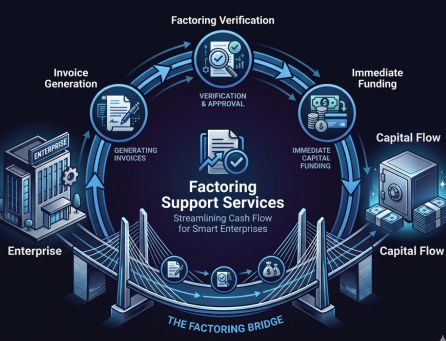
At its core, Factoring Support Services involve selling outstanding invoices to a third-party factoring service provider at a small discount. The provider advances 70% to 95% of the invoice value immediately and handles collections directly with your buyer. Once the buyer pays, the remaining balance is released to you net of the factoring fee. No new loans. No dilution. Just faster access to cash that is already yours.
The process in practice
- Issue invoice to buyer after delivery of goods or services.
- Submit an invoice to the factoring service provider for buyer credit verification.
- Receive 70 to 95 percent of invoice value within 24 to 48 hours.
- Provider manages collections and buyer follow-up on your behalf.
- Receive residual balance once the buyer pays, minus the factoring fee.
The Balance Sheet Impact Finance Leaders Care About
This is where Factoring Support Services move from operational convenience to strategic finance tool. In a non-recourse factoring arrangement, the receivable is fully derecognized under IFRS 9 and GAAP standards. That means the invoices leave your balance sheet entirely, your debt-to-equity ratio improves, your current ratio strengthens, and your return on assets increases in a single transaction.
The measurable outcomes for finance leaders
- Days Sales Outstanding (DSO) compresses from 45 to 90 days down to near zero on factored receivables.
- Current ratio improves because long-dated receivables are replaced with immediate cash.
- Gross receivables are removed from the balance sheet under auditor-validated non-recourse structures.
- Return on Capital Employed (ROCE) rises as freed liquidity is redeployed into higher-yield operations.
What Does Factoring Cost and Is It Worth It
Factoring fees typically range from 1% to 5% of the invoice value per 30-day period. For mid-market enterprises with creditworthy buyers and high invoice volumes, effective rates often compress to 1% to 2% per month. Compare that to the cost of unsecured revolving credit in today's rate environment, then factor in the balance sheet improvement and credit risk transfer, and the economics become difficult to argue against.
Two standard pricing models
- Flat fee model: A fixed percentage applied to the invoice face value regardless of when the buyer pays.
- Variable fee model: A daily or weekly rate charged against the outstanding balance, escalating with late buyer payment.
Which Industries Get the Most from Invoice Factoring Support Services
Invoice factoring support services perform best in industries where payment terms are long, invoice volumes are high, and operational costs do not wait for buyers to settle. The sectors that have standardized receivables factoring support as a treasury instrument include:
- Manufacturing: Raw material procurement and payroll cannot wait 60 to 90 days for buyer payment.
- Logistics and Trucking: Factoring services for trucking companies advance 80 to 90 percent of freight invoice value within 24 hours, keeping fleets running.
- Staffing: Weekly payroll runs 3 to 4 weeks ahead of monthly client billing. Factoring bridges this gap without credit facilities.
- Professional Services: Milestone-based billing creates predictable receivables gaps that selective invoice factoring resolves cleanly.
- Healthcare, Construction and Oil and Gas: Any sector where invoicing precedes collection by 60 days or more benefits materially.
How to Choose the Right Factoring Service Provider
The global factoring services market is projected to grow from USD 4,872 billion in 2025 to USD 12,254 billion by 2033 at a CAGR of 12.7% (Grand View Research, 2025). That growth reflects one thing: enterprises at scale have moved factoring from a niche liquidity tool to a mainstream working capital strategy. Choosing the right outsourced factoring support provider requires evaluating six criteria that go beyond the headline advance rate.
- Advance rate: 70% to 95% of invoice value upfront. Higher is better for immediate liquidity.
- Non-recourse structure: Transfers buyer default risk to the factor, enabling balance sheet derecognition.
- Sector expertise: Vertical knowledge in factoring services for trucking companies, staffing, or manufacturing reduces disputes and accelerates processing.
- Collections quality: The provider's follow-up capability directly affects DSO and buyer relationship management.
- Technology integration: ERP connectivity, real-time dashboards, and automated reconciliation are non-negotiable at enterprise scale.
- Multi-currency capability: Essential for enterprises with cross-border receivables and international buyer networks.
Factoring Support Services vs Your Other Options
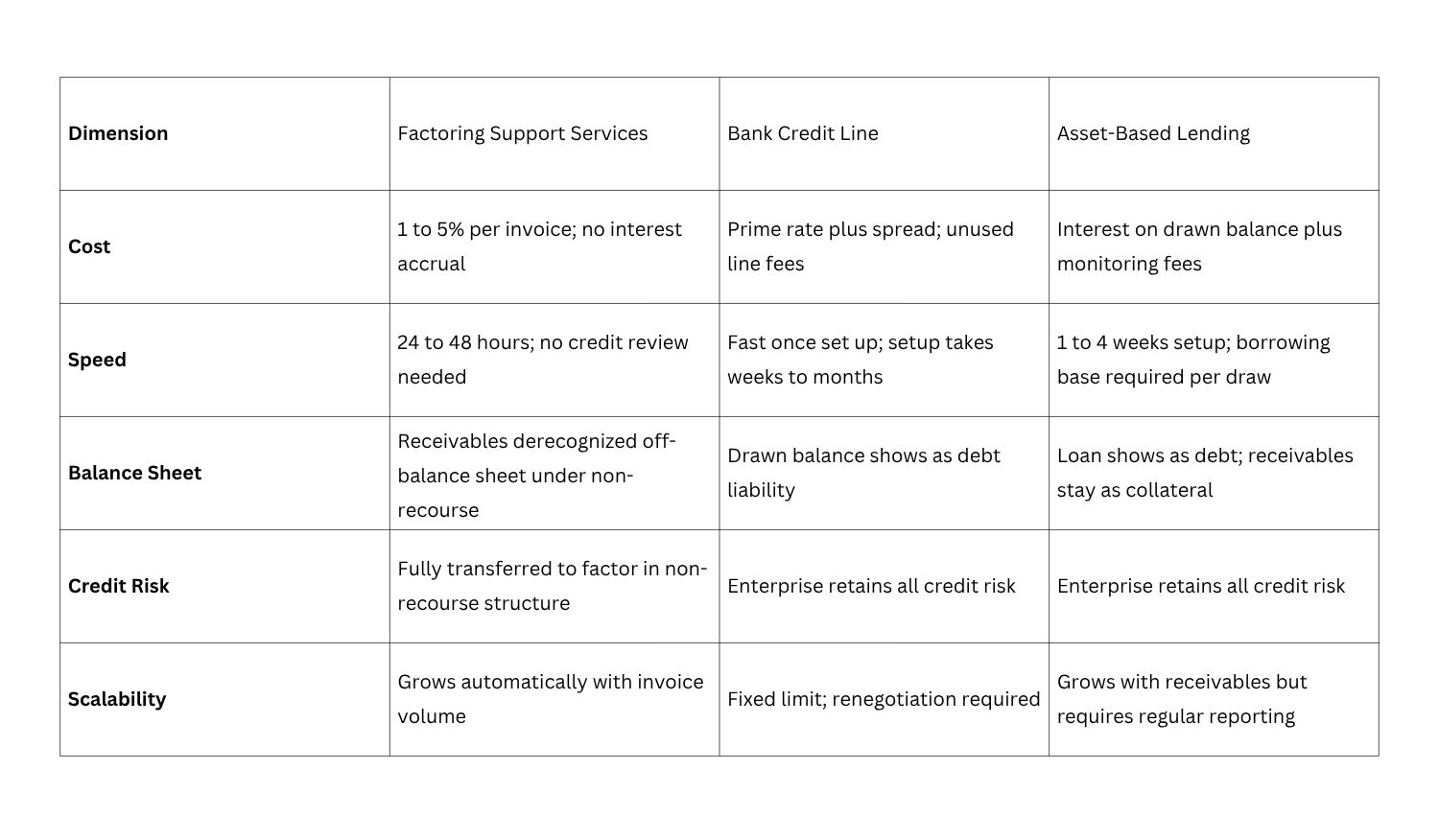
According to Mordor Intelligence, the global factoring market will reach USD 6.30 trillion by 2031, growing from USD 4.68 trillion in 2026. That trajectory signals a decisive shift in how enterprises view receivables financing. Before committing to a structure, finance leaders should compare the available instruments on the dimensions that matter most.
Building a Factoring Strategy That Scales With Your Business
Enterprises that extract maximum value from receivables factoring support treat it as a deliberate treasury strategy, not a short-term fix. The starting point is segmenting the AR ledger by buyer creditworthiness and payment history, a discipline best supported by dedicated accounts receivable outsourcing services, then applying selective factoring to high-volume, slow-paying accounts where the working capital impact is highest.
From there, the factoring service provider's platform should be connected to internal ERP systems for automated invoice submission and real-time reconciliation. Track DSO, cash conversion cycle, and effective factoring cost as CFO-level KPIs on a monthly basis. Governance matters too: SLAs with the outsourced factoring support provider should cover advance timelines, collections escalation, and dispute resolution.
This is where the Invensis model separates itself. Every engagement runs on The Power of Parallel: AI systems and domain specialists operating as concurrent tracks, each validating the other in real time. For enterprise finance teams, that means buyer credit verification, invoice validation, collections follow-up, and reconciliation happen simultaneously rather than sequentially. The result is compressed cycle times, fewer handoff gaps, and a cleaner audit trail, all of which translate directly into lower DSO and a stronger balance sheet.
For enterprises ready to implement a structured approach, explore the full service offering at Invensis Factoring Support Services.
Frequently Asked Questions
What does a factoring service do?
A factoring service buys your outstanding invoices at a small discount, advances 70 to 95 percent of the value immediately, and collects payment from your buyer. You get cash in 24 to 48 hours without taking on new debt.
What is the meaning of factoring services?
Factoring services is a financing arrangement where a business sells its unpaid invoices to a third-party factor at a discount. The factor provides immediate working capital and handles collections. In non-recourse structures, the factor also absorbs buyer default risk.
How much is a factoring fee?
Factoring fees range from 1% to 5% of invoice value per 30-day period, based on industry risk, buyer credit quality, and invoice volume. High-volume enterprises with creditworthy buyers regularly negotiate rates in the 1 to 2 percent range.
Who is a factoring company?
A factoring company is a financial institution or specialist lender that purchases trade receivables from businesses. Factors serve sectors including trucking, staffing, manufacturing, and professional services through both bank-owned and independent structures.
What are the best factoring support services for large enterprises?
The best Factoring Support Services for large enterprises offer non-recourse structures, multi-currency capability, ERP integration, high advance rates, and strong collections infrastructure. Vertical expertise in your specific industry is a significant differentiator.
.webp "Medium")
Kristen is an experienced professional in the factoring support industry, bringing a wealth of knowledge and expertise to her writing. With years of hands-on experience, she adeptly navigates the intricacies of factoring operations. Kristen's proficiency extends across diverse sectors, consistently providing valuable insights and delivering effective solutions. She excels in client onboarding, streamlining invoice processing, and implementing robust risk management strategies. As a prominent writer in the factoring support space, Kristen's expertise shines through in her concise and actionable guidance, empowering businesses to optimize their cash flow and achieve long-term financial stability.
Discover Our Full Range of Services
Click HereExplore the Industries We Serve
Click HereBlog Category
Related Articles
How quickly they turn invoices into cash, we break down what really happens inside the invoice validation clock
June 25, 2026
|

A practical guide for factors to identify invoice fraud, strengthen invoice validation, and protect funding decisions.
June 25, 2026
|
.jpeg)
How modern factoring support services empower factoring companies to scale, manage risk, and protect margins amid tightening credit conditions.
June 25, 2026
|
Services We Provide
Industries We Serve
