 Factoring Support
How Fast Can Your Factor Actually Pay? Inside The Verification Clock

June 25, 2026
|


Content
A successful business story depends on smooth cash flow. Even companies with strong revenue make seamless cash flow their utmost priority because stacked-up bills are signs of severe financial and operational pressure. Delayed customer payments lead to exhausting disruptions, and the cascading effects create strain across the board. This is why many growing businesses turn to factoring services to maintain steady working capital and operational stability.
To cut to the chase, both small and large businesses often have one question: “How quickly can factoring provide access to capital?” One reassuring fact is that it is not like traditional loans that consume time and effort through excessive paperwork. Even so, a clean invoice is required to reduce repeated rounds of approval and the risk of being delayed due to manual verification, especially in cases of discrepancies.
To better understand the process, let’s take a complete glimpse inside the verification clock.
Here’s what they would be looking at:
- Clean invoice
- Valid supporting documents
- Payment terms clarity
- Customer creditworthiness
- Risk assessment score
- Dispute-free status
When unpaid invoices that are less than 90 days old are submitted along with supporting documents, the factoring providers carry out the verification process from their end. The process is accelerated through invoice validation software and ERP-based verification workflows such as Invoice Verification in SAP MM, enabling efficient processing of high-volume invoices without compromising accuracy or control.
While validation software checks authenticity and compliance, leaving no room for duplicates, Invoice Verification in SAP MM drills deeper to avoid scenarios such as overpayment or underpayment.
If you are new to the game and loaded with questions like What is invoice validation? What is an invoice validator? How are invoices validated? What do these software solutions actually do?
Don’t worry, let’s break it down for you!
An invoice validator typically verifies:
- Supplier details
- Invoice number uniqueness
- GST/VAT compliance
- Purchase order matching
- Quantity and pricing accuracy
- Payment terms
- Supporting documents
These are the core validation components as well.
Today, the invoice validation process depends heavily on automation, ERP integration, compliance verification, and payload verification systems working together without slowing down approvals.
Multiple invoice validation processes run in parallel, but here is the window that determines settlement speed:
Invoice Validation + Invoice Verification + Payload Verification – 1 Hour
In optimized systems, invoice validation and verification cycles can be completed quickly. However, this can be achieved only when invoices are clean and free of errors. Even the invoice validity period can influence how smoothly approvals move through the verification cycle.
Once the customer’s creditworthiness is affirmed, a cash advance is approved and received within 24 to 48 hours. Now, that’s real speed, 70%-90% of the funds do arrive faster.
The final phase involves receiving the remaining 10%-30% of the funds once the customer completes the payment.
This combination of invoice validation processing ensures accuracy, compliance, and control even at high volumes by reducing manual intervention and standardizing checks across systems.
Invensis offers such structured and technology-driven workflows support faster and more reliable invoice processing for clients by ensuring that each invoice moves through a controlled, audit-ready verification cycle. Trust Invensis for faster and faultless outcomes!
.webp "Medium")
Kristen is an experienced professional in the factoring support industry, bringing a wealth of knowledge and expertise to her writing. With years of hands-on experience, she adeptly navigates the intricacies of factoring operations. Kristen's proficiency extends across diverse sectors, consistently providing valuable insights and delivering effective solutions. She excels in client onboarding, streamlining invoice processing, and implementing robust risk management strategies. As a prominent writer in the factoring support space, Kristen's expertise shines through in her concise and actionable guidance, empowering businesses to optimize their cash flow and achieve long-term financial stability.
Discover Our Full Range of Services
Click HereExplore the Industries We Serve
Click HereBlog Category
Related Articles

A practical guide for factors to identify invoice fraud, strengthen invoice validation, and protect funding decisions.
June 25, 2026
|
.jpeg)
How modern factoring support services empower factoring companies to scale, manage risk, and protect margins amid tightening credit conditions.
June 25, 2026
|
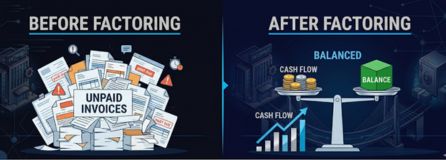
Fix enterprise finances using smart factoring and AI-human collaboration.
June 25, 2026
|
Services We Provide
Industries We Serve
